

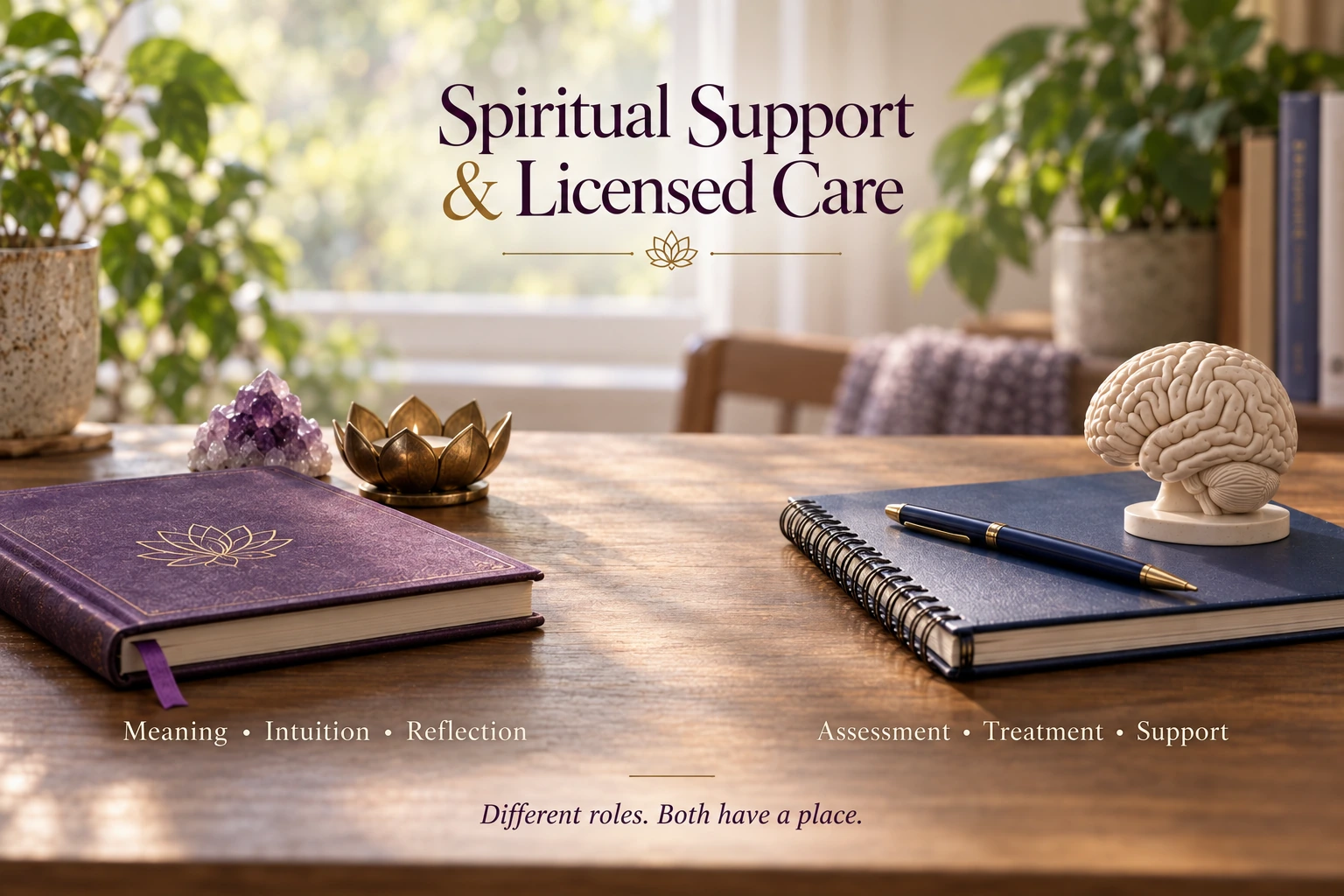
People usually arrive at an intuitive counseling session with a question they’ve already turned over many times on their own—about a relationship, a decision, a challenge, or a pattern that keeps recurring.
What I offer is an opportunity to take that question deeper—sometimes all the way back to its origin. And sometimes there is no particular question. In those cases, I may simply tune in and begin sharing the intuitive perceptions that come forward.
My purpose is not to tell you what to do or how to live your life. It is to help you access a deeper awareness of yourself. In more than thirty years of doing this work, I have found that the most meaningful sessions are those in which a person’s own inner spiritual power begins to come forward. Something they may already have sensed becomes clearer, a pattern suddenly makes sense, or they begin to see themselves and their situation from a much deeper perspective.
For me, that is what this work is ultimately about: self-empowerment.
This guide explains what intuitive counseling is, what happens in a session, where it differs from licensed therapy, and how to decide whether it may be right for you.
Please read first: Intuitive counseling is a spiritual and complementary practice. It is not mental-health treatment. If you are experiencing significant psychological distress, trauma-related symptoms, persistent anxiety, or depression, please work with a licensed mental-health professional. That care can’t be substituted, and I’ll say so directly if I believe professional mental-health care is what you need.

Intuitive counseling combines conversation with intuitive perception to help you explore your experiences, questions, choices, and recurring patterns from a deeper perspective. My work is spiritual rather than clinical; I do not diagnose or treat mental-health or medical conditions.
Intuitive perception is an important part of what I do. As we talk, I may receive impressions about you, the situation you are describing, patterns that may be influencing you, or something deeper that may be asking for your attention. My understanding of the chakra system as centers of consciousness also informs how I perceive the physical, mental, emotional, and spiritual aspects of the whole person.
But your discernment always remains your own. I don’t want you to give your power away to me—or to anyone else. What I perceive becomes part of what we explore together. Ultimately, you determine what resonates and what has meaning for you.

Intuitive counseling | Licensed counseling |
Spiritual and complementary practice | Regulated mental-health service |
Uses intuitive impressions and conversation | Uses established clinical approaches |
Explores meaning, direction, spirituality | May assess and treat mental-health conditions |
No diagnosis, no treatment plan | Assessment and treatment within professional scope |
Reflective and open-ended | Structured toward clinical goals |
These aren’t competing options. Many people work with a licensed therapist while also exploring the spiritual dimensions of their lives. Each has its appropriate place.
Where I’ll decline There are also times when I will decline to work with someone or recommend additional professional support. If someone comes to me in acute psychological distress, is dealing with significant unprocessed trauma, or is seeking guidance that properly belongs with a physician, psychologist, attorney, financial adviser, or another licensed professional, I will say so. Knowing the boundaries of this work is part of practicing it responsibly.
A session begins with you describing what you’d like to explore. But it doesn’t always have to begin with a specific question. Sometimes I simply tune in and begin sharing what I perceive, and we allow the session to unfold from there.
As we work together, I may ask questions, share intuitive perceptions, identify patterns I am noticing, and invite you to consider what resonates. We may explore where a recurring pattern originated, how it has affected the way you perceive yourself or your circumstances, and what might change when you become more conscious of it.
A session will generally include:
Sessions are recorded, and the recording is yours to keep. A great deal can surface during an hour. Something that seemed like a passing comment during the session may take on much greater meaning when you listen to it again days or weeks later.
There’s no correct list. The most useful topics are the ones that actually occupy you—commonly relationships and recurring dynamics, life direction and career questions, spiritual practice and belief, personal patterns that keep repeating, and decisions where you want another perspective alongside the practical facts.
The purpose isn’t to hand your decision to me. My role is to help you become more aware of what is already within you—to recognize patterns, access your own intuitive awareness, and ultimately become more empowered in making your own choices.
I don’t want to become your source of answers. I want to help you become more capable of accessing your own.
Self-awareness means becoming more conscious of your own thoughts, reactions, values, and patterns. An intuitive counceling session creates dedicated space to explore those deeper meanings and a greater sense of self-empowerment, including tools you can use to continue an inner focus that meets challenges.
The questions worth sitting with tend to be simple ones: Why does this keep affecting me? What am I avoiding? What do I really want? Which of my values is driving this? What am I sensing intuitively that my mind may be taling me out of?
Often the most useful moments in a session isn’t something I say. It happens when you hear yourself say something clearly for the first time. Growth isn’t linear, and no session guarantees an outcome, but a period of transition is exactly when a deliberate pause tends to be worth the most.
It is actually you making the ‘pause’ to consider that IS the spiritual juice!

Before booking with anyone, including me, ask what their sessions involve, what training and experience they have, how long a session runs, how they handle confidentiality, and whether they clearly understand the difference between spiritual counseling and clinical mental-health care.
Be cautious of anyone who guarantees a specific outcome, discourages you from seeking appropriate medical or mental-health care, or suggests that spiritual work should replace qualified professional treatment.
Here are my own answers:
A practitioner who can’t answer these plainly is telling you something.
Intuitive counseling is a spiritual and holistic practice that combines conversation with intuitive perception to help a person explore relationships, life direction, recurring patterns, spiritual questions, and deeper aspects of self-awareness. In my work, my understanding of the chakra system as centers of consciousness also informs the intuitive process
The ultimate purpose is not dependence upon the counselor. It is greater awareness and self-empowerment.
No. If you’re experiencing a mental-health condition or significant psychological distress, you should work with an appropriately licensed professional. Intuitive counseling can exist alongside that care as a separate spiritual and complementary practice, but it does not replace it.
I use the term intuitive counseling because much of the work is conversational and perception-based. We explore your questions, patterns, and experiences together, with the goal of helping you develop greater awareness and self-empowerment.
Integrative Chakra Therapy® is different. In ICT, the practitioner acts as a facilitator of subtle energy working through the chakra system, with awareness of the physical, mental, emotional, and spiritual aspects of the Whole Human Being.
No. You don’t have to accept everything I perceive. In fact, I want you to use your own discernment.
I may offer an intuitive perception that opens an entirely new way of looking at something. You may immediately recognize it, you may need time to sit with it, or you may decide it doesn’t resonate. All of that is part of the process.
The objective is not to make you believe in my intuition. It is to help you become more aware of your own.
Intuitive counseling is primarily conversation- and perception-led. Integrative Chakra Therapy® is a subtle-energy modality working through the chakra system. They can complement each other, but they are different forms of work and may be appropriate for different needs.
I’m not going to tell you how to live your life.
I may perceive something about you that you haven’t recognized in yourself. I may help you trace a recurring pattern toward its origin. I may ask a question that causes you to stop and see something differently. And I may help you become more conscious of the intuitive and spiritual awareness that is already within you.
But ultimately, the work is yours.
My purpose is to help you become more self-aware, more trusting of your own inner perception, and more self-empowered.
For me, that is the real value of intuitive counseling. It isn’t about giving your power to someone who claims to have the answers. It is about discovering more of the awareness, intuition, choice, and spiritual power that already reside within you.
And when that happens, you don’t leave simply knowing more about the question you brought in
You leave knowing more about yourself.
If you’re carrying something that hasn’t resolved on its own—or simply feel that there is something deeper within you asking to be explored—that may be the time for a session.
Book a private session with me. If you’d rather experience some of this work first, our Monday Night Chakra Healing and Discourse evenings are held every other Monday in Encinitas and online, free or pay-what-you-can.
Book a private session with me. If you’d rather get a sense of the work first, our Monday Night Chakra Healing and Discourse evenings run every other Monday in Encinitas and online—free or pay-what-you-can.