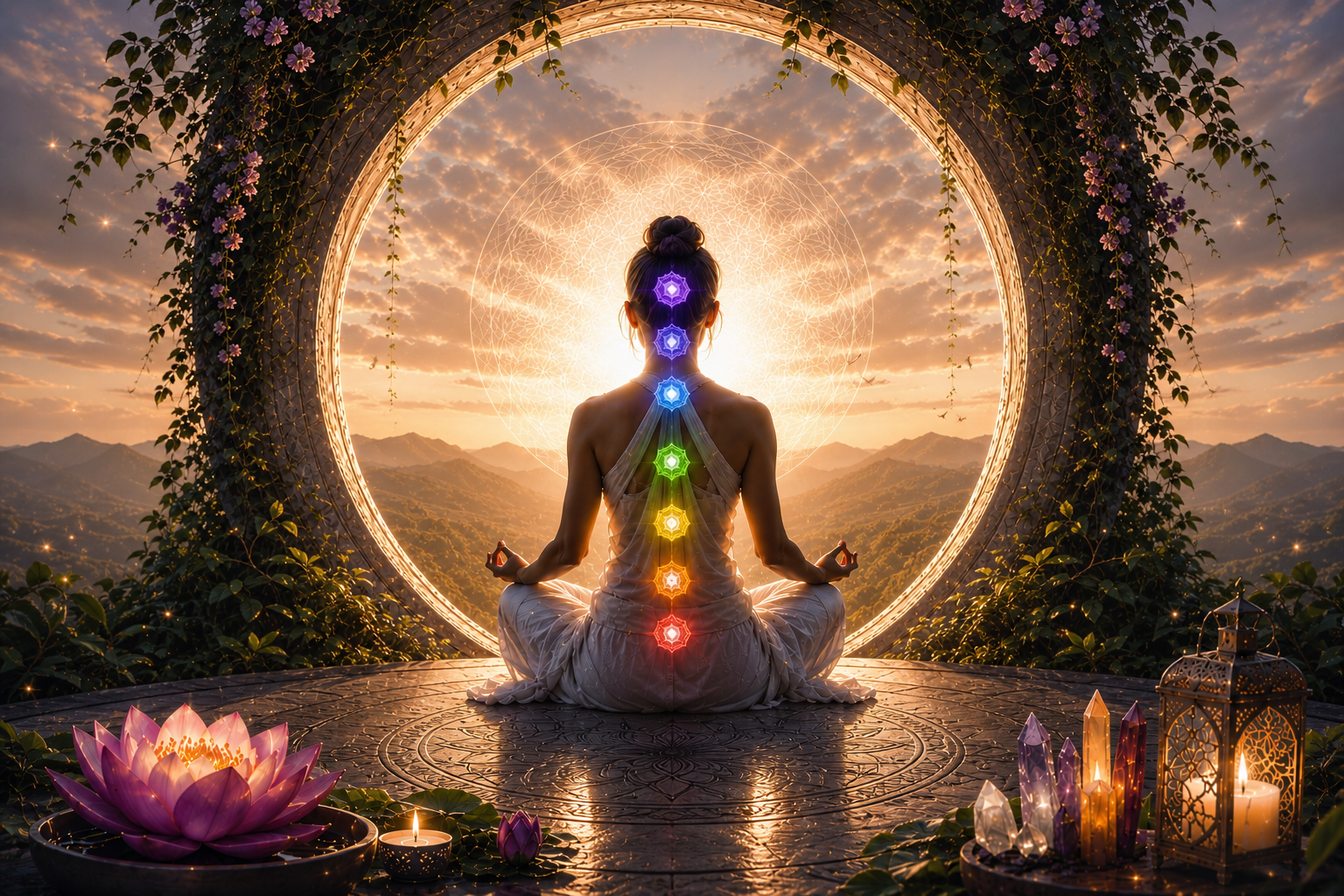

If you have taken a yoga class, opened a meditation app, or walked past a crystal shop, you have probably heard someone mention their chakras. But what are the 7 chakras, really—and why has a concept documented thousands of years ago become one of the most searched ideas in modern wellness?
The seven chakras are the primary centers of consciousness within the subtle body. Through them, consciousness expresses itself in the physical, emotional, mental, and spiritual dimensions of human life. The seven chakras are seven hubs of consciousness aligned along the spine, from its base to the crown of the head. Each one shapes a different dimension of your physical, mental, emotional, and spiritual life. This guide walks through the chakra meaning of all seven, where they sit, what they govern, and how a beginner can start working with them, drawing from more than thirty years of teaching and intuitive consultation at Light News Institute.
The 7 Chakras at a Glance
| # | Chakra | Sanskrit | Location | Color | Element | Governs |
| 1 | Root | Muladhara | Base of the spine | Red | Earth | Safety, belonging, survival |
| 2 | Sacral | Svadhisthana | Below the navel | Orange | Water | Emotion, creativity, self-worth |
| 3 | Solar Plexus | Manipura | Above the navel | Yellow | Fire | Personal power, will, identity |
| 4 | Heart | Anahata | Center of the chest | Green | Air | Love, empathy, connection |
| 5 | Throat | Vishuddhi | Throat | Blue | Ether | Comprehension, Expression |
| 6 | Third Eye / Brow | Ajna | Between the eyebrows | Indigo | — | Intuition, perception, command |
| 7 | Crown | Sahasrara | Top of the head | Violet / white | — | Meaning, transcendence, soul |
What Are the 7 Chakras?
The word chakra is Sanskrit for “wheel” or “disc.” In the yogic traditions where the idea originated, chakras are described as spinning wheels of energy positioned along the spine.
This rests on the understanding that you have both a physical body and a subtle body — an energetic layer, sometimes called the biofield or human aura, that carries life-force energy through channels known as meridians or nadis. The seven major chakras are the points where that energy gathers most strongly. They convert spiritual energy into the chi or prana that moves through your tissues and organs.
The earliest references to these centers of consciousness appear in the Hindu Vedas, texts whose oral roots run back thousands of years. Later tantric and yogic writings elaborated the system into the seven-center map that is taught today, and Western readers first encountered it in translation in the early twentieth century.
What makes chakras difficult to grasp at first is that they are not simply batteries of energy. They are gateways of consciousness. Each carries specific attributes — especially intuitive capacities — that influence the four archetypes of the whole human being: physical, mental, emotional, and spiritual.
For a deeper look at the biofield and how chakras anchor the physical body, see Chakras 101.
Why Are Chakras Important?
Each of the seven centers influences a different dimension of your life, your perspectives, and your perceptions: from basic safety through self-expression to spiritual connection. When conscious awareness and intuitive awareness move freely through all seven, you feel grounded, expressive, and at ease in yourself, and true spiritual growth occurs. When it presents as a challenge or opportunity at one or more chakras, that imbalance tends to surface as physical tension, recurring emotional patterns, or a persistent sense of being slightly off. Although one chakra generally predominates at any given moment, it is not necessarily your lifelong “dominant chakra.” Recognizing which center is currently shaping your perceptions and choices is one of the most valuable insights of chakra study.”
There is a further layer that beginners rarely encounter elsewhere. At any given moment, one chakra usually exerts more influence over your thoughts, perceptions, and choices than the others. Recognizing which center is most active — or can even be your dominant chakra — explains a great deal about why certain patterns keep returning in your relationships, your work, and your inner life. It is the difference between reading a general description and recognizing your inner powerful attributes.
Understood this way, the chakra system stops being abstract. It becomes a practical map for self-empowerment: Do I feel safe in my own life? Am I expressing what I actually mean? Am I aware of a connection to something larger than myself?
The 7 Chakras Explained
Here is each of the seven chakras in turn, moving from the base of the spine to the crown.
Root Chakra (Muladhara)
Location: Base of the spine · Color: Red · Element: Earth
Muladhara means “root support,” and it is the foundation of the entire chakra system. It governs your most basic needs: safety, shelter, sustenance, and belonging. When the root is balanced, you feel settled and secure in your body and in your life. When it is not, there is often a quiet, persistent sense of being unmoored—anxiety, restlessness, or the feeling of living a life that belongs to someone else.
The work at the root is rarely about fixing circumstances. It is about coming home to yourself.
Sacral Chakra (Svadhisthana)
Location: Lower abdomen, below the navel · Color: Orange · Element: Water
Svadhisthana translates roughly as “the home of the original self.” This center governs emotion, creativity, inspiration, and self-worth, mirroring the adaptability of its water element. Balanced, it shows up as healthy emotional flow and creative energy. Out of balance, it can look like emotional numbness, creative blocks, difficulty holding boundaries, or a sense that your worth depends on how others treat you.
Read more: The Sacral Chakra (Svadhisthana)
Solar Plexus Chakra (Manipura)
Location: Upper abdomen, above the navel · Color: Yellow · Element: Fire
Manipura means “lustrous gem.” This is the seat of personal power, identity, and personal truth—the engine behind motivation and self-esteem. When it is balanced, you act from your own truth. When it is not, the imbalance tends to swing between two extremes: shrinking, deferring, and making yourself smaller so others are comfortable, or gripping, holding to your authenticity so nothing can lead you off guard. Both are the same energy moving in opposite directions.
Heart Chakra (Anahata)
Location: Center of the chest · Color: Green (sometimes pink) · Element: Air
Anahata means “uncharted or unbounded—a love so profound it is difficult to convey. As the midpoint of the seven, the heart bridges the more physical lower chakras and the more spiritual upper ones, governing compassion, empathy, and connection. Its particular difficulty is not that the feeling stops but that it becomes so much that a person eventually goes numb to get through the day. Grief, overwhelm, and difficulty trusting are common signs of lower aspects of the heart chakra.
Read more: The Heart Chakra (Anahata)
Throat Chakra (Vishuddha)
Location: Throat · Color: Blue · Element: Ether (sound)
Vishuddhi means “to purify.” The throat chakra is often described as the communication center. In my experience, that description misses its deeper function. Vishuddhi is fundamentally the chakra of comprehension: of perceiving and processing on a higher level others do not always match and carrying the quiet ache of being understood only in part. A balanced throat chakra supports higher self-expression and a feeling of efficacy. A Lower Aspect throat chakra shows up as withdrawal, isolation, or the sense that speaking rarely leads to being heard.
Read more: The Throat Chakra (Vishuddhi)
Third Eye Chakra (Ajna)
Location: Forehead, between the eyebrows · Color: Indigo
Ajna means “command.” Often called the third eye or brow chakra, it relates to intuition, imagination, and inner knowing. When it is active, perception can run ahead of the ordinary range—patterns, systems, and dimensions others have not yet noticed. That is a genuine gift, and it comes with a genuine challenge: a mind that moves faster than the world around it and real difficulty grounding itself. The work is not to dim the perception but to build the capacity to stay in the body while keeping it.
Read more: The Brow Chakra (Ajna)
Crown Chakra (Sahasrara)
Location: Top of the head · Color: Violet or white
Sahasrara means “thousand-petaled,” after the traditional image of a lotus at the crown. This is the gateway of the soul—the place where the individual self desires to merge toward something larger. When it is functioning well, there is a settled sense of purpose and peace. When it is in a lower aspect, there may be cynicism or a persistent feeling that something is missing. The invitation here is not to believe harder, but to move from belief into direct inner experience.
Read more: The Crown Chakra (Sahasrara)
The Dominant Chakra
Each chakra is a center of consciousness, not just energy. One chakra of the seven is usually “dominant” for a lifetime. Like being right-handed, you tend to favor your right hand for writing and other activities, though there is nothing wrong with your left hand. The dominant chakra tends to shape how you perceive the world, how you interpret your experiences, and how you naturally respond to life’s situations.
It is the same with the chakras: one may be dominant, but the other six chakras are still active. It is important to know that while one chakra is dominant, challenges and opportunities can arise in any of the chakras.
Chakra Colors and Their Meanings
The rainbow of chakra colors is the most recognizable feature of the modern chakra system, with each center represented by a different hue moving up the spine.
This particular color coding is more recent than most people assume. Historians trace the ROYGBIV mapping to twentieth-century Western writers; the older Sanskrit sources described each chakra through lotus petals, seed sounds, deities, and symbols rather than a fixed palette. That does not make the colors wrong — they have become a genuinely useful shorthand, and color is a real property of light and vibration. It simply means the colors are a doorway into the system rather than the system itself.
- Root – Red: grounding, strength, survival
- Sacral – Orange: creativity, emotion, self-worth
- Solar Plexus – Yellow: confidence, willpower, identity
- Heart – Green: love, harmony, compassion
- Throat – Blue: truth, clarity, expression
- Third Eye – Indigo: intuition, insight, perception
- Crown – Violet / White: spirituality, transcendence, connection
Many beginners use these colors as an entry point — choosing a candle, a crystal, or even a shirt in the shade of the chakra they are working with that day.
Signs of Chakras in Their Lower Aspects
Although there is no such thing as a “blocked” chakra, they can exhibit what are called “Lower Aspects” and “Higher Aspects.” Every chakra expresses both higher and lower aspects. A lower aspect is not a defect or failure. Rather, it represents an opportunity for growth in one or more dimensions of your physical, emotional, mental, or spiritual life. A higher aspect emerges as consciousness expands and those opportunities are integrated into greater wisdom and self-empowerment. The chakras are your doorways to higher levels of consciousness and self-empowerment.
Because each governs a different area of life, the signs differ depending on which center is affected. Broadly, look for:
- Physical signs: tension in the related area—tight hips near the sacral, a constricted throat near the throat chakra
- Emotional signs: recurring anxiety, low self-worth, grief, jealousy, or numbness
- Behavioral signs: people-pleasing, over-control, procrastination, trouble holding boundaries
- Energetic signs: feeling scattered, stuck, disconnected, or out of sync with your own life
These patterns overlap with ordinary stress and with diagnosable health conditions. Chakra work is a spiritual and self-reflective practice. A trained Integrative Chakra Therapy® practitioner serves as a guide rather than a fixer. The goal is to help you awaken your own inner knowing in a safe, grounded, and self-empowering way. Persistent physical or emotional symptoms are always worth discussing with a qualified healthcare provider.
If you want a structured starting point, our free chakra assessment identifies which of the seven is most active for you right now in about two minutes.
How to Balance the 7 Chakras Naturally
Chakra balancing is less a one-time correction than an ongoing practice of paying attention. The most common beginner approaches:
- Chakra meditation — bring attention to each center in turn, root to crown, often paired with visualizing its color. Our guided group meditations have used this approach since 1992.
- Yoga — certain postures are traditionally associated with certain centers: grounding poses for the root, heart-opening poses for the heart.
- Breathwork — slow, deliberate breathing helps move energy that has gone stagnant.
- Sound and mantra — each chakra is paired with a seed sound, or bija mantra, chanted to help activate it.
- Journaling — write through the question each chakra asks: safety, creativity, power, love, comprehension, intuition, connection. Notice where the writing stalls.
- Time in nature — walking barefoot outdoors remains one of the simplest ways to ground the root chakra.
You need no equipment and no special training to begin. Five or ten quiet minutes a day is a real start. For deeper, guided work, Integrative Chakra Therapy® sessions offer an intuitive assessment of your chakra system alongside practical tools you can use on your own.
Benefits of Chakra Healing
Chakra healing is a general term for any practice—meditation, yoga, sound work, or subtle energy balancing—aimed at restoring balance across the seven centers.
Many of the individual practices involved carry well-documented benefits. Research summarized by the National Center for Complementary and Integrative Health, part of the U.S. National Institutes of Health, has associated mindfulness and meditation practices with improvements in anxiety and depression symptoms and in sleep quality, with the strength of the evidence varying by outcome.
Beyond the measurable, people who work consistently with their chakras commonly report:
- Greater calm and steadier emotional regulation
- Sharper body awareness — noticing tension before it becomes pain
- A reliable structure for processing difficult emotions
- A stronger sense of purpose and spiritual connection
- Clarity about which patterns are actually theirs to change
Greater awareness expands consciousness.
Expanded consciousness produces wiser choices.
Wiser choices create self-empowerment
As with any complementary practice, chakra healing works best alongside medical and mental health care, not in place of it.
Common Myths About Chakras
Myth: You need psychic ability to work with your chakras.
No particular gift is required. Because everyone possesses chakras as centers of consciousness, everyone possesses the capacity for intuition. Like any human capacity, however, it develops through awareness and practice! Anyone can begin with meditation, breathwork, or simply learning what each center governs. Intuitive capacity develops through practice—it is not a prerequisite for it.
Myth: Chakras are physical organs.
They are part of the subtle body, the human biofield or aura. You would not find them in a dissection, though their locations correspond closely along the spine and to the major nerve plexuses and endocrine glands.
Myth: A “blocked” chakra means something is wrong with you.
There is no such thing as a blocked chakra. Chakras can have many attributes in their Higher or Lower aspects, including strong, weak, deficient, and so on. An active or imbalanced chakra marks where your attention and growth are currently concentrated. It is information for you to take advantage of, as it is your “higher self” communicating to you through your chakras!
Myth: You should work on all seven at once.
Beginners almost always progress faster by starting with the one center that is most active right now and letting the others follow. Finding a qualified teacher is important for you to grow in the “safe way.”
Myth: Chakra healing replaces medical treatment.
It does not, and it should not be presented that way. It is a complementary spiritual practice that works alongside evidence-based care.
Conclusion
The seven chakras offer a framework thousands of years old for understanding how body, mind, and spirit actually connect. Learning the basics—Root, Sacral, Solar Plexus, Heart, Throat, Third Eye, and Crown—gives you a working vocabulary for noticing where you feel grounded and where you are holding tension.
Chakra work rewards consistency far more than intensity. Start small: identify the one center that matches where you are right now, spend five minutes with it, and notice what shifts. Greater awareness is always the first step toward greater self-empowerment.
Ready to go further?
Take the free chakra assessment to find your most active center, join a Monday Night Chakra Healing and Discourse session online or in Encinitas, or book a private session with Dr. Jelusich.